In Memoriam
Memory of Dr. Xuebin Yin
Professor Dr. Xuebin Yin passed away due to illness on July 25, 2026 at 9:09 a.m. in Suzhou, China. The selenium community lost an enthusiastic and influential researcher.
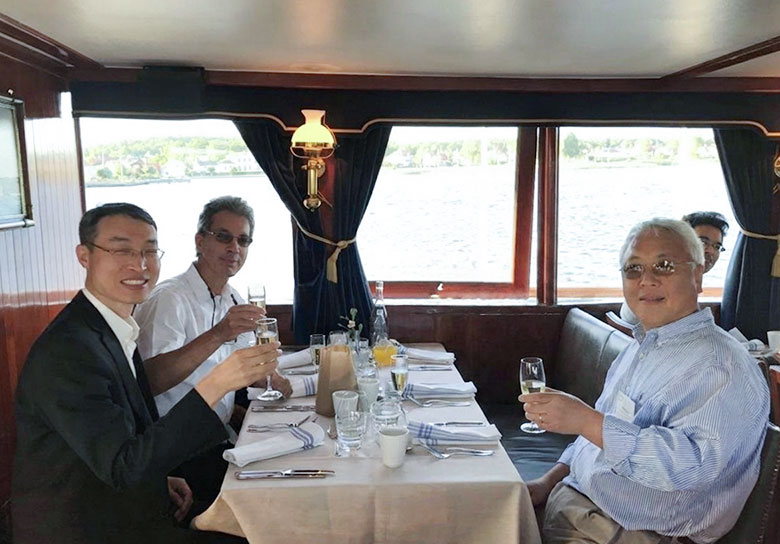
My 19-year relationship with Dr. Xuebin Yin started with an introduction to him from Dr. Zhi-qing Lin while we had a meeting in China. Zhi-qing and I were already well acquainted with each other because of our joint selenium activities with each other in California with his previous post-doc advisor Professor Norman Terry at University of California at Berkeley. During a trip to China, Zhi-qing thought it would be a good idea for me to meet Dr. Yin to discuss the potential opportunities of promoting selenium research in China, particularly organizing an international conference on selenium in Suzhou, China. My first impression of Dr. Yin was that he appeared to be very gentle, soft-spoken, had a nice smile and a fond appreciation for selenium. Clearly, our connection was established because of our joint appreciation for selenium. Thus, the three of us continued our discussion about the possibility of organizing an international selenium conference. Soon after, the three selenium-appreciating minds decided to organize a new selenium conference series with gracious financial support through Dr. Yin and from local sources including “Suzhou Industrial Park”, University of Science and Technology of China (USTC), etc. Little did we know at that time there would be seven more conferences to follow this first one in the following two decades. In the beginning planning stages for the first conference, I had difficulties trying to explain the important concept of “Happy Hour” for our first conference to Dr. Yin. I told him this was an important part of the conference to promote interaction between participants – not drinking like a local at a banquet. I struggled with convincing him and finally told him that I would simply buy wine and beer myself, set up a table, and serve as bartender at the conference. At the end, he finally agreed to include the “Happy Hour” in the conference program! After this conference, the three of us expanded our selenium vision with a suggestion from Dr. Yin who thought it would be great to form an international society for selenium research that could be based in China. This idea was also an exciting thought to ponder for the new future of selenium research and the selenium conferences. Then three of us slowly developed this idea and eventually, under the careful guidance of Zhi-qing, we worked on creating guidelines for a new organization. The International Society for Selenium Research (ISSR) was presented to participants at the third selenium conference held in Hefei, China. I was elected by the working group as President; Dr. Yin was elected as Secretary and Zhi-qing was elected as Treasurer. The Society now had the function of coordinating the selenium conference every 2 years and importantly, promoting international collaborations among the many facets of selenium research worldwide. Consequently, and thereafter, I came to China often in preparing for our future selenium conferences, and always I was full time with Dr. Yin at each visit. Because of these conferences and my love for the city of Suzhou, and for USTC where Dr. Yin taught, I came to Suzhou several times a year. I would give guest lectures, teach classes and interact with Dr. Yin’s students and his research associates, including Dr. Linxi Yuan who was my translator and travel companion and is now a professor at Xi’an Jiaotong-Liverpool University in Suzhou. Time spent with Dr. Yin was not always easy. He oftentimes changed his plans or schedules with me at the last minute, and indeed, that was very annoying. He always wanted me to meet other selenium people in China, including government officials, industry representatives, other researchers and importantly selenium-interested students. Every two years, Dr. Yin, Zhi-qing and I worked together with a guest conference host from another country to co-organize the next conference, as demonstrated by the following eight conferences in Suzhou (2009), Suzhou (2011), Hefei (2013), São Paulo (2015), Stockholm (2017), Xi’an (2019), Bangkok (2023), and Chuzhou (2025). Now we have already started the planning for the 9th conference in Turin, Italy for 2027. With all earlier conferences, the process was somehow the same - Zhi-qing and I would first discuss the conference plan, then I would come to Suzhou and meet Dr. Yin because we needed his blessing and gracious funding support since he provided essential support for our invited speakers, published books, and encouraged the Chinese scientific community to attend. Without his input and support, the international selenium conferences would not have successfully taken place over the years. Even though Zhi-qing and I were getting things initiated and done, we always needed his support to help care for our invited speakers. I feel that in addition to Dr. Yin leaving two major imprints for the selenium community with his initial vision of creating the International Selenium Research Society and co-organizing our biannual selenium conferences, Dr. Yin was responsible for developing the National Biofortification Program (NBP) in China with international selenium experts, as well as developing the selenium biofortification industry and its selenium-enriched products in China. In the recent years, Dr. Yin was in the process of expanding the concept of “Functional Agriculture” in China by including selenium, zinc and iodine for nutrient deficient regions of China. For over two decades, Dr. Yin and I developed a very close selenium-connecting bond. With my active participation as a selenium speaker throughout all parts of China with him, I provided him with international recognition that he needed in China and for me, he made me and my selenium research well known, accepted and truly recognized in China. We helped each other grow into becoming two very good friends based upon our great appreciation for selenium, our selenium conferences and our desire for a living selenium research society.
Dr. Yin lives within the international selenium community. His spirit has become another facet of selenium in China and in many parts of the world. He and his great efforts for expanding the selenium world will be missed. But we must remember, Selena the selenium goddess once said - “long live selenium, and let friends live bonded with Selena”!
Gary S. Banuelos, USDA-ARS Soil and Plant Scientist, Parlier California