
The 8th International Conference on Selenium in the Environment and Human Health has been successfully held in Chuzhou, Anhui, China on July 6-9, 2025
The 8th International Conference on Selenium in the Environment and Human Health has successfully been held on July 6-9, 2025, at the Sheraton Hotel in Chuzhou, Anhui, China. The conference was co-organized by Anhui University of Science and Technology in Chuzhou, China and International Society for Selenium Research.
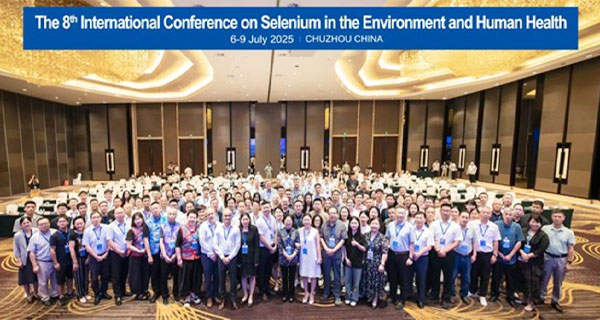
The conference convened under the theme "Selenium for a Healthy World." It attracted over 260 participants from more than 10 countries, including Germany, the United States, France, Sweden, Italy, Belgium, Thailand, Brazil, and China.
The conference focused on 12 topics including the origin and distribution of selenium, its metabolic mechanisms in plants, and its effects on human health. A total of 100 academic abstracts were accepted, featuring 24 poster presentations, 42 authoritative expert presentations, and 12 student oral presentations. A dedicated exhibition session on selenium-enriched industry was also organized along with the research presentations, where numerous enterprises showcased their latest products and technological achievements.
The successful conclusion of this conference has not only strengthened communication and cooperation among global selenium researchers but also made significant contributions to addressing global health challenge of "hidden hunger" through selenium science.
The conference was featured with two keynote speeches: Autoimmunity to Its Transporter Offers Novel Insights into the Physiological Role of Selenium by Lutz Schomburg at Charité Universitätsmedizin Berlin, Germany; Selenium Biofortification: Strategies, Progress and Challenges by Xuebin Yin at Anhui Science and Technology University. Accepted abstracts were peer-reviewed and published in the Proceedings of 8th International Conference on Selenium in the Environment and Human Health. The proceedings are open access at the society website: http://www.seleniumresearch.pro/publication/conference-proceedings/.
Student Awards at the 8th International Conference on Selenium in the Environment and Human Health
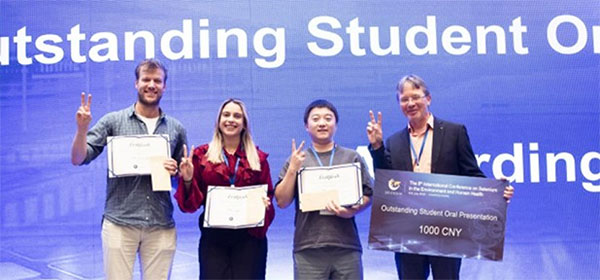
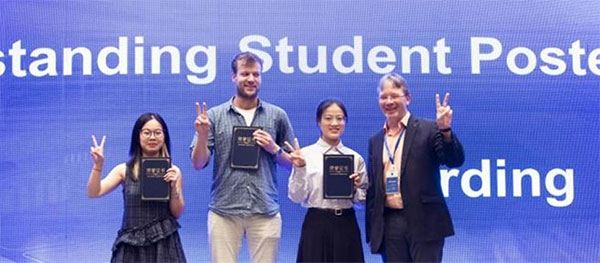
There were 12 oral and 24 poster presentations by student selenium researchers in the Student Session at the 8th International Conference on Selenium in the Environment and Human Health. Three students have been selected to receive the Best Student Oral Presentation Awards and three for the Best Student Poster Presentation Awards:
Jeroen van der Woude at Wageningen University was awarded the Best Student Oral Presentation Award. His oral presentation: An Atlas of Plant Selenium Metabolism: A Model to Help Interpret Modern-omics Data in Selenium Research.
Zheng Lei at Huazhong Agricultural University received the Best Student Oral Presentation Award for his presentation entitled Dynamic and Stable Core Microbiota Assist Plants in Enriching Selenium and Reducing Cadmium Absorption.
Maria Lanza at São Paulo State University was honored with the Best Student Oral Presentation Award for her presentation entitled Enhancing Food Security: Advances in Plant Nutrition with Selenium.
Yidan Wang at Xi’an Jiaotong-Liverpool University won the Best Student Poster Presentation Award for her presentation entitled Screening, Identification, and Evaluation of Selenium- and Zinc-Enriched Probiotic Strains.
Yi Liu at China Agricultural University received the Best Student Poster Presentation Award for her presentation entitled Bioreduction and Volatilization of Selenium by Delftia acidovorans R25.
Jeroen van der Woude at Wageningen University also received the Best Student Poster Presentation Award.
The Student Session was coordinated by Professor Linxi Yuan at Xi’an Jiaotong-Liverpool University. The award judges were Professor David Churchill at Korea Advanced Institute of Science and Technology, Professor Miao Li at Anhui Agricultural University, Professor Yu Tao at China University of Geosciences, Professor Andre dos Reis at São Paulo State University, Professor Xiaohu Zhao at Huazhong Agricultural University, and Professor Michela Schiavon at University of Turin.